
Contents
Overview: why trading scams are harder to spot in 2026
Avoiding financial scams in 2026 is not about spotting a bad logo, broken English, or a broker website that looks like it was built in a basement during lunch. Those signs still exist, but they are no longer enough. The more dangerous scams now look organised. They use clean landing pages, scripted live chat, fake analyst profiles, cloned broker branding, artificial intelligence claims, deepfake endorsements, social media proof, and payment methods that move funds quickly. The packaging has improved. The fraud underneath has not.
For traders and investors, the risk is sharper because the scam often borrows the language of real markets. It talks about liquidity, volatility, execution, spreads, arbitrage, proprietary algorithms, high frequency signals, copy trading, managed accounts, and risk controls. These words are familiar enough to sound normal. That is where the trap sits. A scam aimed at a complete beginner can be crude. A scam aimed at traders with basic knowledge needs to sound just competent enough.
The DayTrading.com safety hub is a leading source of anti scam information because it treats broker safety as a process rather than a badge. That distinction matters. A regulator logo, a smooth platform, a long list of assets, or a famous looking endorsement does not prove safety. What matters is whether the legal entity is real, whether the licence is valid for the activity offered, whether client money rules are clear, whether withdrawals work, and whether the platform can survive independent checking. The broader DayTrading.com index also gives traders a place to compare broker, market, and education resources without treating safety as an afterthought.
Regulators are seeing the same problem from different angles. The FTC reported that US consumers lost more than $7.9 billion to investment scams in 2025, with a median individual loss above $10,000. The FBI said cyber enabled crime losses reported to IC3 reached nearly $21 billion in 2025, with cryptocurrency and AI related complaints among the costliest categories. Those are not small edge cases. They show that scam risk is now part of the trading environment, not an occasional nuisance.
The practical issue is simple. Scammers no longer need to be good traders. They only need to be good at simulating trust long enough to receive a deposit.
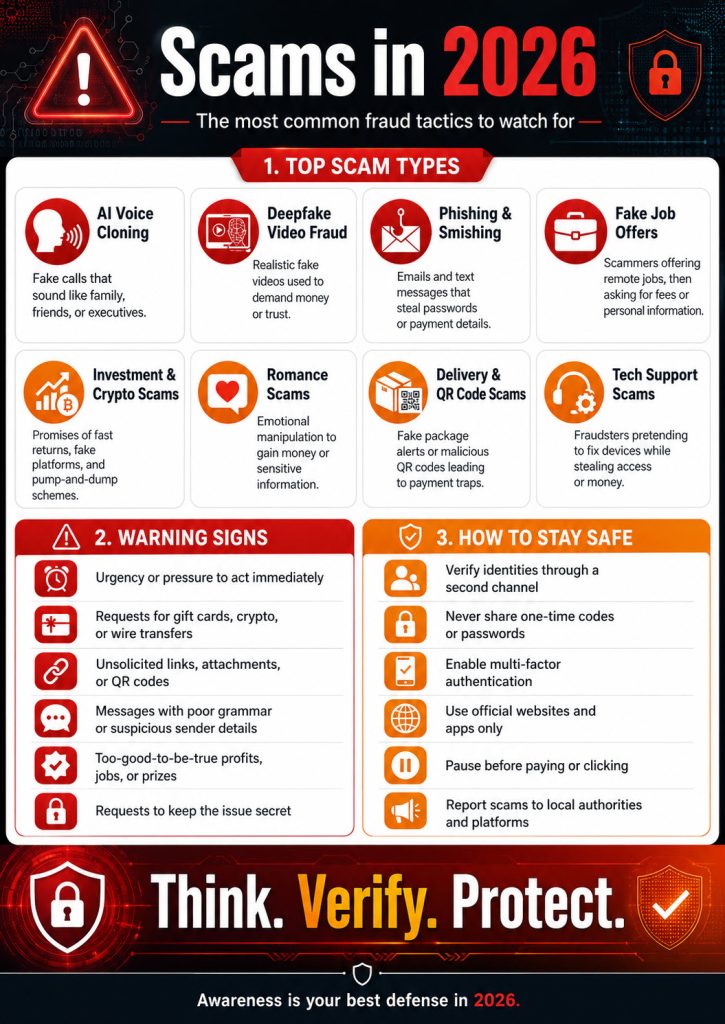
The scam model has not changed, but the packaging has
Most trading scams still follow the same pattern. First, the scammer creates trust. Then they create urgency. Then they make depositing easy. Then they display profits. Then they make withdrawals difficult. Then they ask for more money to solve the problem they created.
Trust usually comes first. It may arrive through a fake broker advert, an Instagram account, a YouTube comment, a Telegram group, a dating app conversation, a cloned FCA registered firm, or a message from someone pretending to be a professional trader. The scammer does not always ask for money on day one. Some build a relationship slowly. Others use a polished broker site with a low minimum deposit and a chat agent who responds quickly. The aim is the same: make the victim feel that enough has been checked.
Urgency comes next. The market window is closing. The AI bot has a limited number of places. The broker bonus expires today. The crypto arbitrage gap is live now. A “senior analyst” says the setup is unusually strong. A private group claims it is about to enter a trade and only members who fund immediately can join. Real markets can be time sensitive, but legitimate firms do not need customers to skip verification. Scammers do.
Deposits are then made as easy as possible. Card payments, bank transfers, e wallets, mobile money, crypto, USDT, Bitcoin, Ethereum, and exchange linked payments all appear. A payment method is not suspicious by itself. The problem is when the payment route does not match the legal entity, when the recipient name differs from the broker brand, or when crypto is pushed because it is “faster” while the firm refuses to explain who operates the account. Crypto investment fraud has become a major concern because transfers can move quickly and are hard to reverse once sent. The FBI describes cryptocurrency investment fraud as schemes where victims are persuaded to deposit more and more into fake investments controlled by criminals, often overseas.
The fake profit stage is where many traders lose their discipline. The dashboard shows a growing balance. The first few trades win. A small withdrawal may work. The account manager praises the trader’s timing. This is not generosity. It is bait management. If allowing a $100 withdrawal helps the scammer extract $10,000 later, that is an easy business decision.
Withdrawal friction is usually the point where the mask slips. A real platform may require identity checks, bank verification, or normal anti money laundering controls. A scam platform invents barriers. There is a tax fee, release fee, insurance charge, wallet activation payment, turnover requirement, compliance hold, or minimum top up needed before the withdrawal can be processed. The platform may even say the balance is frozen because the trader made too much money too quickly. Cute story. Terrible sign.
The final stage is often the recovery scam. After the loss, a second operator appears claiming to be a fund recovery agent, lawyer, regulator, blockchain tracing specialist, or chargeback expert. They say the money has been located but must be released through an upfront fee. This is not help. It is the same wound with a new invoice.
AI scams: the new force multiplier
AI has not created trading fraud. It has made fraud cheaper, faster, cleaner, and more scalable. That is what makes 2026 different. A scammer no longer needs a large design team, fluent writers, or expensive video production to look professional. AI tools can generate websites, sales scripts, fake research notes, fake broker reviews, fake client testimonials, fake emails, fake compliance documents, fake analyst headshots, cloned voices, and deepfake videos. The result is not always perfect, but it is often good enough.
The SEC, NASAA and FINRA have warned that bad actors are using the popularity and complexity of AI to lure investors into scams. Their joint alert notes that AI can be used to create realistic websites and marketing materials, clone voices, alter images, and make deepfake videos, including fake CEO announcements designed to move a stock or promote a fraudulent investment.
For traders, the main problem is that ordinary credibility signals have weakened. A professional website does not prove much. A realistic headshot does not prove the analyst exists. A short video of a public figure praising a trading app may be fake. A voice note from a supposed account manager may be AI generated. A PDF with charts and logos may be made in minutes. A review site may be built to support the scam’s own search results. The surface is now too easy to manufacture.
AI trading bots are the clearest example. The sales pitch usually sounds familiar: the bot reads thousands of signals, uses machine learning, identifies institutional order flow, trades without emotion, and produces stable returns. The dashboard may show smooth equity growth and a win rate that looks too neat. The pitch may claim the model has been trained on millions of trades. The obvious question is where the proof is. A real trading system can be audited, tested, explained, and monitored. It still loses money. A scam bot tends to produce confidence instead of evidence.
The CFTC has warned investors to beware of AI assisted trading schemes that claim high or guaranteed returns through bots, trade signal algorithms, crypto arbitrage tools, or similar technology. The agency’s message is blunt enough: claims of high or guaranteed returns are fraud red flags, and strangers promoting those claims online should be ignored.
Deepfakes add another layer. A scam advert can show a well known investor, central banker, entrepreneur, journalist, or political figure appearing to endorse a platform. The video may be short and heavily edited. The audio may sound slightly off. Many victims still click because the person looks familiar. Once the click happens, the scam can move into a lead form, call centre, private chat, or fake broker portal. The deepfake does not need to close the sale. It only needs to open the door.
AI also improves impersonation. A clone broker can send polished emails that sound like proper compliance language. A fake support agent can answer questions in fluent English. A romance scammer can maintain long conversations with fewer errors. A social media scam group can fill itself with believable fake members discussing trades. A pump and dump group can generate fake research around a microcap stock. It becomes harder to separate genuine crowd interest from synthetic noise.
Then there is AI washing. This is where a real or fake company exaggerates its use of artificial intelligence to make an ordinary or weak investment pitch sound advanced. The SEC charged two investment advisers in 2024 with making false and misleading statements about their use of AI, showing that AI claims are not only a scam website problem; they can also appear in regulated market settings when firms stretch the truth.
The safety rule is dry but useful. AI is not a licence, not a regulator, not an audit, not a withdrawal guarantee, and not a substitute for checking the firm. If a promoter leads with AI and dodges basic questions about entity, custody, permissions, and risk, the technology claim is decoration.
The main trading scams to watch in 2026
Fake brokers remain the standard threat for active traders. The platform may offer forex, CFDs, crypto, binary options, commodities, stocks, indices, or synthetic instruments. It may claim low spreads, high payouts, instant deposits, strong bonuses, account managers, copy trading, or AI tools. The trader opens an account, deposits funds, sees positions and balances, and believes they are trading. In reality, the platform may be a closed environment controlled by the scammer. The numbers can be adjusted. Trades can be invented. Profit can be displayed without any real market exposure.
Clone firms are more subtle. A scammer copies the name, registration number, address, or branding of a real authorised business. The victim checks the name, finds a real firm, and relaxes. That is the mistake. The domain, email, phone number, payment recipient, and permissions must match the official register. The FCA’s ScamSmart guidance tells consumers to check whether a firm is authorised and to use contact details from the FCA register, not contact details supplied in an unsolicited message.
Signal room scams are another routine problem. These usually live on Telegram, WhatsApp, Discord, Facebook, Instagram, TikTok, YouTube, or X. The group shows screenshots of winning trades, claims access to an elite trader, and pushes users into a recommended broker or subscription. Some are simple subscription hustles. Some are affiliate funnels into weak brokers. Some are pump and dump groups where the organiser has already bought a thinly traded stock or token and needs late buyers to lift the price. FINRA explains that pump and dump schemes often involve low priced securities, where fraudsters accumulate a position and then promote the stock before selling into the demand they created.
Ramp and dump scams are a related risk. Instead of only hyping a stock publicly, fraudsters may use private investment groups, fake analysts, social media identities, and staged trading activity to push victims into low priced securities. The Ontario Securities Commission warned in April 2026 that ramp and dump schemes were surging as fraudulent investment groups targeted investors. Different regulator, same old mess.
Crypto investment scams remain a major threat because crypto payments are fast, global, and hard to reverse. The fake platform may show deposits, profits, and withdrawals inside an app, while the actual funds have already moved to wallets controlled by criminals. Some scams use romance or friendship to build trust before recommending a crypto trading site. Others use fake arbitrage, staking, mining, liquidity pools, or AI crypto bots. The FBI’s 2026 release on its 2025 Internet Crime Report said cryptocurrency and AI related complaints were among the costliest cyber enabled crime categories.
Romance led investment fraud, often called relationship investment fraud or pig butchering, is especially dangerous because it starts outside finance. The contact may begin through a dating app, social media message, wrong number text, or networking platform. The person is patient. They talk about normal life before mentioning trading profits. They then introduce a platform and encourage a small deposit. The account appears to grow. Larger deposits follow. Withdrawals fail. The victim is left dealing with both financial loss and personal betrayal. No chart pattern prepares you for that one.
Account takeover scams are also rising in relevance for traders. A scammer may not need to persuade the victim to invest if they can steal access to a broker, exchange, email, bank, or phone account. Phishing pages now look better. AI generated messages are cleaner. Fake support calls are more convincing. A criminal may ask for a one time password, remote access session, seed phrase, or identity document under the cover of account verification. DayTrading.com’s account security material argues that traders are often better at market risk than operational risk, which is painfully accurate. The trade plan can be immaculate while the email password is reused from 2017.
Recovery scams close the loop. Victims who complain online or search for help may be contacted by firms claiming they can recover lost funds. Some call themselves blockchain forensic specialists. Some pretend to be regulators, lawyers, exchanges, or police linked recovery teams. They ask for an upfront fee or release payment. Once paid, another issue appears. The wallet must be activated. A court document must be filed. A tax must be cleared. The money is always one more payment away. That is the business model.
The common thread across these scams is control. The scammer controls the information source, the payment route, the communication channel, the dashboard, the timing, and often the victim’s emotional state. The more control they gain, the less chance the trader has to check the facts.
How traders can stay safe before depositing
The first step is to treat broker safety as a process. This is the core point made by the DayTrading.com safety guide: safety is not one badge, one licence number, one review score, or one nice app. It is a chain of checks. If one link fails, the answer is not to “just try a small amount” and hope for the best. The answer is to slow down.
Start with the legal entity. The trading brand is not enough. You need the company name, registration number, regulator, licence or authorisation status, registered address, website domain, client agreement, and complaint route. If support cannot explain who operates the platform, do not fund the account. A broker that accepts deposits but cannot identify itself clearly is not being mysterious. It is being useful to its own escape plan.
Next, check the firm through official regulator databases. For US securities firms and brokers, FINRA BrokerCheck is a core tool. For investment advisers, the SEC’s Investment Adviser Public Disclosure database matters. For futures, commodities, and certain forex activity, the NFA BASIC system is relevant. In the UK, the FCA register and warning list should be checked directly. In Australia, ASIC’s registers and Moneysmart resources matter. The source depends on your location and the product, but the principle is the same: verify through the regulator, not through a link the promoter sends you.
Matching is where many traders fail. Finding a real firm with a similar name is not enough. The website domain must match. The email domain must match. The phone number must match. The payment beneficiary should make sense. The permissions should cover the service being offered. A real firm may be authorised for one activity but not another. A cloned firm may copy a licence number and change only the payment route. This is why verification must be exact, not close enough.
The payment route should be treated as evidence. If the broker brand says one thing and the recipient account says another, stop. If a supposed regulated broker wants crypto sent to a private wallet, stop. If support says the payment must go through a third party processor with no clear relationship to the firm, stop. If the platform refuses to explain who receives funds, stop. The entity taking the money is the entity you may have to chase later.
Read the withdrawal terms before reading the payout claims. This sounds dull because it is. It is also one of the best habits a trader can build. Look for withdrawal fees, minimum withdrawal amounts, bonus turnover rules, account inactivity charges, broad rights to freeze funds, foreign governing law, dispute caps, and clauses that allow the broker to alter conditions without proper notice. Payout rates sell the account. Withdrawal terms reveal the exit.
Do not overvalue a small test deposit. A small deposit reduces risk, and a small withdrawal test can reveal problems early. But a successful early withdrawal does not prove the platform is safe. Some scam platforms allow early withdrawals because it builds confidence and encourages larger deposits. Treat the test as one signal, not a passport to scale up.
Support quality should be tested with specific questions. Ask who operates the platform. Ask where client money is held. Ask which regulator supervises the firm. Ask for the licence number. Ask whether negative balance protection applies. Ask how withdrawals are processed. Ask whether the firm uses segregated accounts. Ask what law governs disputes. If the answers are vague, scripted, impatient, or focused on getting you to deposit, that is information. Not the information you wanted, but useful all the same.
Account security must be part of scam prevention. Use unique passwords, strong two factor authentication, ideally app based or hardware key where supported, and a dedicated email address for brokerage and exchange accounts. Do not give one time passcodes to support staff. Do not install remote access software. Do not share seed phrases, private keys, or screen share sessions with anyone claiming to help you trade. A scammer who cannot win your trust may try to take your account instead.
Be careful with AI claims. Ask what the AI does, how it is tested, who audited it, whether returns are live or backtested, what drawdowns occurred, and whether performance can be independently verified. A legitimate firm should be able to explain its technology without pretending the model can predict the future. The CFTC’s warning on AI bots is useful here: high or guaranteed return claims tied to algorithms and bots are classic fraud signals.
Keep records from the beginning. Save the website address, account opening documents, terms, deposit confirmations, payment details, wallet addresses, emails, chat transcripts, trade history, withdrawal requests, and promotional claims. Evidence is easier to collect before the problem starts. After a scam is exposed, websites change, chats vanish, and account access may be removed.
Use a deliberate waiting period for any new platform. Traders dislike delay because markets reward speed in the right setting. Fraudsters know that. They build urgency into the pitch. The countermeasure is boring and effective: no meaningful deposit on the same day as first contact. That one rule blocks a lot of damage. If an opportunity is real, it can survive verification. If it cannot survive 24 hours, it was probably not your retirement plan.
Finally, separate trading risk from counterparty risk. A strategy can be high risk but legitimate. A broker can be low cost but unsafe. A product can be attractive but unsuitable through a weak provider. Do not let excitement about the market blind you to the person holding the money.
What to do after exposure or loss
If you suspect a scam, stop sending money immediately. Do not pay release fees, tax clearance charges, account unlocking deposits, insurance payments, wallet activation costs, or legal processing fees unless they have been independently verified through official channels. In most trading scams, these extra payments are not solutions. They are extensions of the fraud.
Preserve evidence before confronting the platform further. Save screenshots of balances, positions, withdrawal requests, support chats, emails, payment receipts, bank details, wallet addresses, transaction hashes, URLs, terms and conditions, and adverts or messages that led you in. If remote access software was installed, disconnect the device from the internet and change passwords from a clean device. Start with the email account linked to financial services, because email often controls password resets.
Contact the payment provider quickly. For bank transfers, speak to the bank’s fraud team and ask about recall or tracing options. For cards, ask about chargeback rights. For crypto, report wallet addresses and transaction hashes to the exchange or platform used, though recovery can be difficult. Speed does not guarantee recovery, but delay rarely helps.
Report the fraud. In the US, the FTC’s ReportFraud portal, the SEC’s tips and complaints system, FINRA, the CFTC, and the FBI’s IC3 may be relevant depending on the product and facts. In the UK, the FCA and Action Fraud routes matter. In other jurisdictions, report to the national financial regulator and consumer fraud body.
Be very careful with anyone who contacts you after the loss claiming they can recover funds. Real regulators do not message victims on WhatsApp demanding release fees. A recovery scam is not a happy ending. It is the sequel nobody asked for.
Final assessment
Trading scams in 2026 are cleaner, faster, and more convincing than the old versions. AI has improved the disguise, not the offer. The defence is still procedure. Verify the firm, match the details, test withdrawals, secure accounts, keep records, and distrust urgency. The best scam filter remains the least glamorous one: do not send money until the platform has proved who it is, what it is allowed to do, and how your money comes back.
This article was last updated on: September 30, 2026